The Moment the Room Splits
You turn to write a tempo marking on the board. It takes maybe eight seconds. When you turn back, the front row is on bar twelve, the middle group is still on bar nine, and three students in the back have quietly set down their instruments and started watching each other. The ensemble that was almost — almost — locking in has fractured into three separate rooms.
The time cost is obvious. You stop, reset, count off again. Five minutes gone. But the less visible cost is the one that compounds: students who were starting to hear themselves as part of a group suddenly hear only noise. That sense of collective sound — fragile at the best of times with elementary ensembles — does not come back automatically. Some students will spend the rest of the period playing cautiously, afraid to commit, because they are no longer sure where they are supposed to be. Confidence in music is built on synchronization. When the group stops sounding like a group, the individual stops believing they can be part of one.
What the Methods Courses Skipped
Music teacher preparation programs do a thorough job with repertoire selection, sight-reading, and Kodaly versus Orff debates. What they tend to skip is the operational layer: what happens when you have twenty-seven students, four different instrument parts, two students who need simplified notation, one student who lost their sheet before they even sat down, and fifteen seconds to get everyone on the same starting bar before the window closes.
Nobody walks you through managing simultaneous parts in real time with varying instrument experience in the same room. Nobody explains that for a significant portion of elementary students, reading a physical page of sheet music while tracking a conductor, managing an instrument, and listening to their own sound is a coordination task that exceeds what their working memory can hold comfortably. The methods courses prepare you to teach music. They are less focused on preparing you to manage a classroom ensemble — which turns out to be a different skill set.
Why Paper-Based Sheet Distribution Breaks Down
Physical sheet music looks like a solved problem until you run the logistics in a real classroom. Printed copies go home in backpacks and do not come back. Students end up with last week's version when you have corrected the notation. A student who needs enlarged print or a simplified part requires a separate stack that has to be sorted and distributed before anyone can start — and any delay to the start of an activity in a K-8 music class has a compounding effect on what comes after.
The deeper issue is cognitive. John Sweller's research on cognitive load theory, first published in 1988, established that working memory is finite and easily saturated. When students have to manage a physical artifact — finding the right page, keeping it flat, tracking their finger position — they are spending mental resources on the artifact instead of the music. In practical terms: less listening, less internalizing, less actual learning. The sheet becomes a distraction from the task it is supposed to support.
When instructional material is designed in a way that increases extraneous cognitive load, it directly reduces the capacity available for learning the target skill.— Sweller, 1988
In sheet music distribution for classroom ensemble management, the paper itself often becomes that extraneous load. The solution is not better paper handling. It is removing the paper handling from the equation entirely.
The Synchronization Problem Nobody Names
Here is the thing most music teacher strategies in K-8 do not address directly: keeping a classroom ensemble on the same bar is a coordination problem. It is not a discipline problem. When students skip ahead or lose their place, the usual response is to frame it as inattention or off-task behavior and apply a behavioral fix. But most students who drift are not being defiant. They are navigating a visual tracking task — reading notation, following bar progression, monitoring their own playing — without a reliable shared reference point. They are not misbehaving. They are lost.
A conductor's hands solve this in a professional ensemble because every player is watching the same source of truth. In a classroom of twenty-five elementary students with varying reading levels and instrument experience, that model breaks down. A student who is still decoding the notation cannot simultaneously watch the teacher's hands. A student managing the physical grip of an instrument for the first time is not going to catch a subtle tempo cue from across the room. The teacher ends up conducting traffic instead of teaching — and the traffic still does not move cleanly.
What the room actually needs is a visible, synchronized reference that every student can track independently, without requiring them to watch the teacher at all. That frees the teacher to move, listen, and respond — which is the actual work of elementary music instruction.

How Classroom Rhythm Closes the Gap
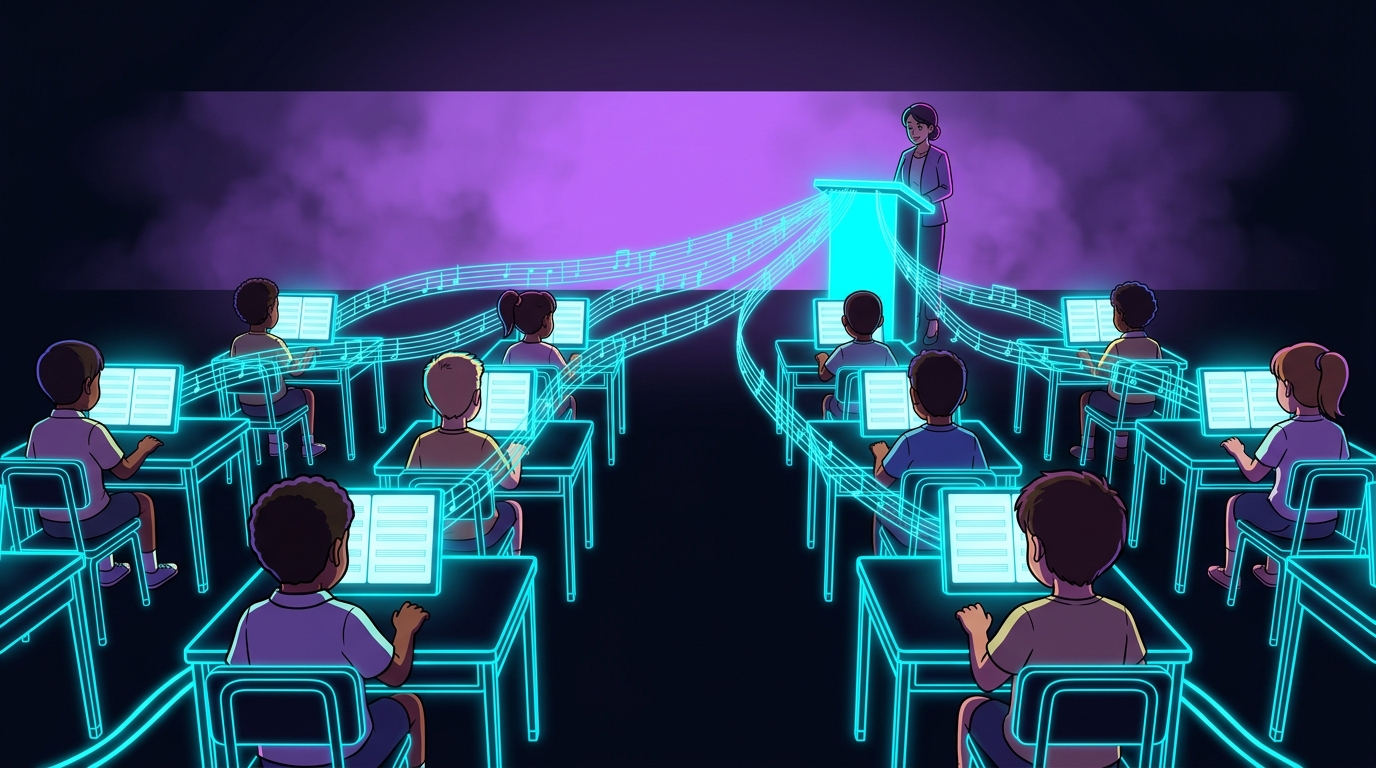
Classroom Rhythm was built around exactly this logistics problem. The teacher controls pacing, part assignment, and page navigation from a single dashboard. When the teacher advances the score, every student's view updates simultaneously. There is no version mismatch, no lost page, no student on bar twelve while someone else is on bar nine. Sheet music distribution happens instantly, in the correct version, formatted for each student's assigned part — including any students who need an adapted or simplified version.
Because the real-time music sync runs through the teacher's interface, the teacher is no longer tethered to the front of the room. They can walk to the back row, crouch next to a student who is struggling with fingering, and the rest of the ensemble stays together. The synchronization is handled by the tool. The teacher's attention is freed for the work that actually requires a teacher: noticing when something clicks, adjusting dynamics on the fly, responding to the room instead of managing it.
For linguistically diverse learners and early readers managing both notation and a new language, the reduction in page-management load is significant. Fewer competing demands on working memory means more capacity available for the musical task itself.
What Changes When the Room Stays Together
When the logistics are handled, something shifts in the room. Students start listening differently — not just to themselves, but to the ensemble as a whole. The teacher can address tone and dynamics and phrasing because those conversations are now possible. The moment where a student genuinely hears something lock in, where they realize they are contributing to a sound larger than their own instrument — that moment is only available when the group is actually synchronized.
No platform automates musicianship. That part is still yours. But it is worth protecting, and the way to protect it is to stop spending your instructional minutes on bar-tracking and paper logistics.
One concrete place to start: before your next rehearsal, identify the two or three moments in the lesson where your attention typically has to split between sections. Map where the ensemble fragments. That is your synchronization gap — and once you can see it clearly, you can design around it.
